
Precious metals are apparently waking up. And here is where you can find the best deals.


Site:
Precious metals news
Putin addressed the summit remotely and emphasized in his speech that de-dollarization is "gaining momentum" and the declining global dominance of the dollar is an "objective and irreversible" process. He projected an optimistic view about BRICS's future, especially when China's Xi Jinping is promoting BRICS as a geopolitical challenger to the G7. Xi, attending the summit in South Africa, sparked discussions on BRICS's potential to counterbalance the G7, causing tensions about whether BRICS should focus on economic interests or position itself against the West.
 Mortgage Rates Spike as US New Home Sales Soar To 17-Month Highs In July
Aug 23, 2023 - 07:30:44 PDT
Existing home sales dropped, but new home sales surged by 4.4% month-over-month, a 31.5% annual increase. The gap between new and old home sales widens. With a decreasing supply, new home prices rose in July despite higher mortgage rates. The current disparity between standard 30-year mortgage rates and what homeowners pay is the largest since the 1980s, making new homes, bolstered by builder subsidies, a primary option. How long can homebuilders maintain this trend without impacting profitability?
Manhattan tops the U.S. for living costs, 122% above the national average, according to C2ER's Cost of Living Index. This index uses a composite score derived from six categories: housing, utilities, groceries, transportation, health care, and miscellaneous goods/services. A score of 100 is the national average.
The 15 priciest urban areas based on these scores are:
1. Manhattan: 222
2. Honolulu: 179
3. San Francisco: 169.9
4. Brooklyn: 159.1
5. Orange County, CA: 150.3
6. Los Angeles: 149.1
7. Washington, D.C.: 148.7
8. Boston: 148.4
9. Seattle: 144.5
10. San Diego: 142.5
11. Arlington, VA: 140.1
12. Oakland, CA: 140
13. Queens: 136.3
14. Bethesda-Gaithersburg-Frederick, MD: 135.8
15. Nassau County, NY: 135.2.
Aug 23, 2023 - 06:39:30 PDT
Mortgage applications plummeted 4.2% in the week ending August 18, 2023, as revealed by the MBA's grim data. This includes a sharp 5% dive in new purchases and a 3% slump in refinancing. The widening chasm between Bankrate’s 30-year rate at 7.62% and the meager effective rate of 3.595% signals a turbulent housing market, further destabilized by concerning economic policies.
 American Workers Are Demanding $80,000 a Year Just to Keep Up With Inflation
Aug 23, 2023 - 06:34:07 PDT
Workers' desired wages to accept a new job hit a record high this year, reflecting ongoing inflation in the labor market. The New York Federal Reserve reported that the average minimum acceptable salary to switch jobs surged to $78,645 in Q2 2023, an 8% rise from the previous year and a 22% increase over the past three years. This wage growth is a primary contributor to inflation, which remains above the Fed's 2% target. While employers are offering higher salaries, there's still a gap between what workers expect and what they're offered. This tight labor market could pressure the Fed to maintain higher interest rates. The labor market also displayed other concerning trends: a decline in job seekers and job openings, and a reduced likelihood of job-switching.
Global interest rates are set to rise, further destabilizing the already vulnerable banking system. The contraction of bank credit, indicative of a severe credit crunch, is just beginning. Rising price inflation is eroding currency purchasing power, leading to even higher interest rates and bear markets. The potential withdrawal of $32 trillion of foreign investment from the fiat dollar and BRICS's move away from the dollar could exacerbate the crisis. Broad money, mostly comprised of commercial bank deposits, is contracting globally. China's credit issues are becoming evident, defaulting on bond payments. Past financial safety nets may prove ineffective this time, as mounting unproductive debts threaten to overwhelm banks and drive the economy to a critical tipping point.

US job growth for the year through March is expected to significantly underperform previous estimates, with a potential shortfall of 500,000 jobs. JPMorgan Chase & Co. predicts a substantial downward revision to the March employment figures. This weaker outlook contrasts sharply with last year's optimistic employment data, which influenced the Federal Reserve's aggressive interest-rate hikes. Discrepancies in the data suggest the labor market may not be as robust as previously believed, casting doubt on the US economic outlook and potentially stalling future rate hikes.
Germany experienced its sharpest decline in activity since May 2020, and France saw its third consecutive monthly drop in output. The euro area is projected to contract by 0.2% in Q3. These dismal figures suggest the economy is struggling, causing the 10-year German yield to plummet. The likelihood of an ECB rate hike next month has decreased from 55% to 40%.
 More Banks Get Credit Downgrades as Financial Crisis Continues to Bubble Under the Surface
August 23, 2023

The financial crisis precipitated by rising interest rates continues to bubble under the surface.Earlier this month, Moody’s cut the credit rating of 10 small and midsize banks. It also placed six large banks on review for potential downgrades and revised 11 more banks from a stable outlook to a negative outlook.This week, S&P Global followed Moody's lead and downgraded the credit ratings of five banks. It also lowered the outlook for several others
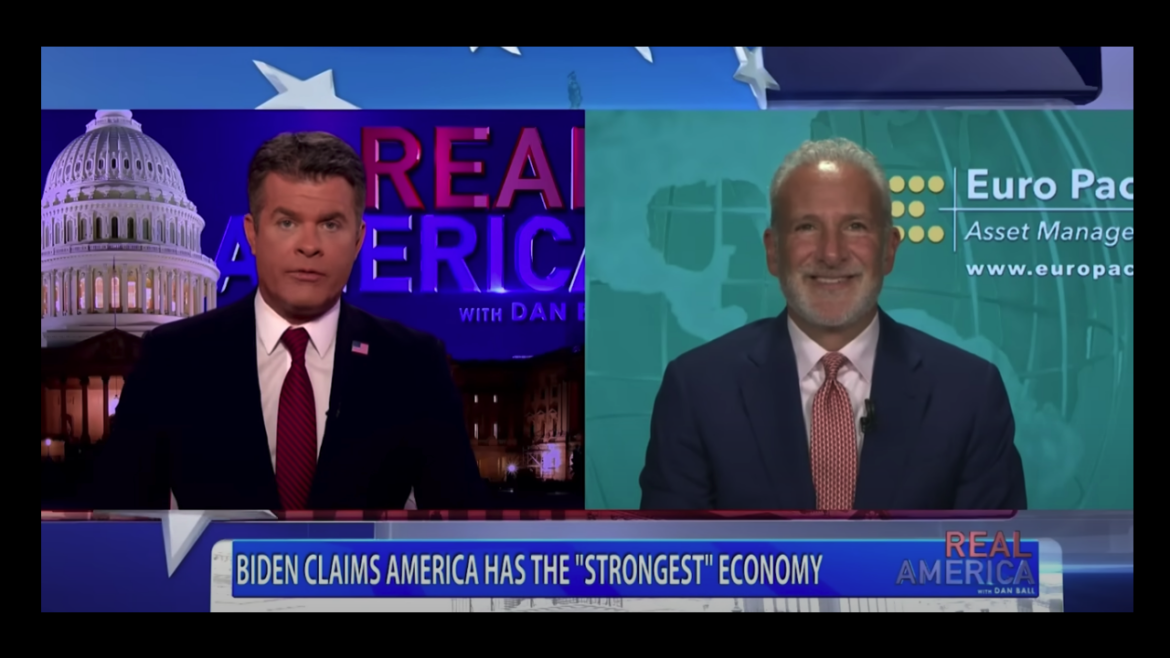
The BRICS summit is underway with talk of expanding the economic block and speculation about a "new currency." Peter Schiff appeared on Real America with Dan Ball to talk about these developments, saying the BRICS nations will blunt Western dominance.

The national debt has climbed to a staggering $32.7 trillion. In just the first two months after Congress reached a deal and suspended the debt ceiling for two years, the national debt surged by $1.2 trillion.And there is no end in sight.

Since price inflation took off in the wake of pandemic-era stimulus, Americans have blown through their savings and run up their credit cards to make ends meet. Now they're starting to have a hard time paying those credit card bills.The number of Americans rolling credit card debt from month to month is now higher than the number of people paying their bills in full for the first time ever.

Gold futures rose on Tuesday, bolstered by a dip in U.S. 10-year Treasury yields. As analysts see signs of stabilization in gold prices, all eyes are on Federal Reserve Chairman Jerome Powell's upcoming speech. Any insights on monetary policy developments, especially after recent uncertainty from the Federal Reserve's minutes, could influence gold's trajectory. Economic data on the U.S. job market and inflation will also play a crucial role in determining gold's performance.
Despite a recent 12% dip in silver prices influenced by economic factors, the metal remains a hot commodity. Earlier this year, silver saw a surge, especially driven by industrial demand in China. Importantly, global silver demand consistently outpaces supply. Technological advancements and consumer behavior changes have opened new markets for silver, particularly in electrification and jewelry. Indian demand for silverware and jewelry soared last year, reflecting robust economic recovery. Looking forward, silver's appeal is poised to stay resilient, with potential supply shortages and consistent global demand lending optimism to its market value.

Despite warnings since April 2022, the U.S. economy looks robust. However, concerns persist:
1. **Federal Reserve's Interest Rate Hikes:** There's been a steep increase from near zero to 5.5% in 16 months. Although immediate repercussions haven't been evident, such rapid hikes typically have delayed negative effects.
2. **Inflation and Spending:** Even if inflation seems controlled, cumulative price hikes since the pandemic's onset could eventually curtail consumer spending.
3. **Industrial Decline:** Industrial production is trending downward, signaling potential broader economic issues.
4. **Bank Lending Standards:** Over half of banks are tightening lending standards for businesses, which can hamper growth and employment.
5. **Inverted Treasury Yield Curve:** This typically precedes a recession. The curve has been inverted since last year, hinting at investor concerns.
6. **Market Overconfidence:** Current market strength might be deceptive, overshadowing looming economic challenges.
The housing market is displaying alarming signs reminiscent of the catastrophic 2008 crash. Notable warning signs include:
1. **Unsustainable Price Spikes**: Rapid housing price surges may indicate a looming bubble. Current trends suggest that prices are plateauing after such increases.
2. **Risky Mortgage Practices**: An uptick in high-risk lending, such as subprime mortgages, echoes the irresponsible lending seen prior to the 2008 crash. These risky loans contributed significantly to the previous economic collapse.
3. **Rising Mortgage Rates**: As rates climb, demand for properties may decline, leading to a potential drop in home prices.
4. **Speculative Buying & Overbuilding**: An influx of speculative property buying and excessive construction can lead to market oversupply, pushing prices down.
5. **Economic Downturn**: A weakened economy, marked by reduced disposable income and job losses, hampers housing demand. Recent surveys show declining consumer confidence in the housing market.
In July, existing home sales plummeted more than expected, marking a 2.2% month-over-month decline and a stark 16.6% decrease year-over-year. This drop is the worst since 2010 and even surpasses the lows during the COVID lockdowns. NAR Chief Economist Lawrence Yun highlighted that inventory availability and mortgage rates have negatively impacted buyers. Builders have tried to boost sales through various means, but their efforts are running short. A concerning trend suggests that new home prices may soon dip below existing home prices, a phenomenon last observed during the 2005 housing bubble. There's a significant disparity between homebuyer and homebuilder confidence, and with mortgage rates as an indicator, the market may face further turmoil.
The Wall Street Journal suggests a shift in the Federal Reserve's focus towards higher inflation targets. While current efforts aim to stabilize inflation below 3%, a target above 2% might be more beneficial as it could help cushion the economy against severe downturns. This, however, raises concerns about the real benefits of inflation. Historically, routine consumer price deflation has been seen as beneficial. However, central bankers' attempts to combat it have resulted in damaging asset bubbles. Economists often overlook asset inflation, focusing primarily on consumer inflation, leading to continuous problems. The debate around inflation expectations is also under scrutiny, with many viewing it as a flawed theory. Despite these criticisms, there's a push for higher inflation targets, echoing similar "temporary" measures in the past, such as Nixon abandoning the gold standard in 1971. This shift emphasizes the ongoing value of gold in turbulent economic times.
Deflation followed by inflation ultimately results in long-term inflation. The value diminishes when liquidity is scarce, so one needs resilience to weather financial storms. Quick financial maneuvers might be overly optimistic given the unpredictable market ahead. The current Consumer Price Index (CPI) doesn't reflect true inflation and has been adjusted over the years to depict a more controlled economic scenario. This manipulation means that actual living costs due to inflation are likely much higher than reported. Having assets that hold their value is important.

The U.S. and Europe's decreasing CPI inflation, termed the "Great Phony Postpandemic Disinflation," isn't due to central bank policies but natural post-pandemic dynamics. Despite the Fed's "success" celebrations, the dollar's value has decreased since the pandemic's onset. Recent monetary conditions indicate hidden inflation risks, with the post-pandemic period showing signs of asset inflation. As 2023 progresses, there's growing concern about the return of glaring monetary inflation and the potential shift from asset inflation to deflation, exacerbated by geopolitical tensions and fluctuating trade. The Fed's pivotal role in global financial stability remains evident.