
Precious metals are apparently waking up. And here is where you can find the best deals.


Site:
Precious metals news


Bill Murphy believes that precious metals prices will explode, but not until this happens first. Here are the details...

What can we make of the November FOMC statement? Is it good for gold? Bad for gold? Irrelevant? Here is some insight...

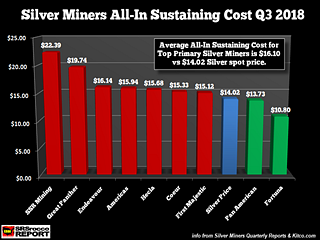
The Primary Silver Miners lastest results were quite dismal as their All-In Sustaining Costs to produce silver were considerably higher than the market price. Many of the silver miners production costs increased in the third quarter of 2018 due to higher energy, material, and labor costs. Only one silver mining company out of the group...
Despite all of the warning signs, the mainstream is still convinced the "economic boom" will continue and the Fed will keep pushing interest rates up. As a result, the price of gold has stayed relatively low. But as Peter pointed out in his most recent Gold Videocast, their complacency is ill-advised, and gold is a mispriced asset. Now is the time to buy.
 Drop in Credit Card Spending Could Signal Problems in Economy Built on Consumer Debt
November 13, 2018

Americans took on another $10.9 billion in debt in September, according to data released by the Federal Reserve. That pushed total consumer debt to a seasonally adjusted $3.95 trillion. American indebtedness is growing at a 3.3% rate.But there are signs that American credit card borrowing is slowing down and that's not good news in an economy built on consumer spending and debt.


Later in the afternoon, US stocks pared some losses (S&P finished off 3 to 2733). The 10-year yield slid to 3.141%, while the DX retreated to 97.20. Gold was $1,201 bid at 4PM – unchanged.
 Tariffic Irony: New US/China Annual Trade Deficit Record for First Time in 12 Years
Nov 13, 2018 - 12:22:24 PST

After all the saber-rattling, all the jawboning, all the tit-for-tat tariff action: The US will almost certainly have the largest trade deficit it has ever had with China this year, the first time it has set a new record in 12 years.

In this week's concise update, Stewart names four reasons why gold & silver investors should now be sporting a decent golden smile...

Investors are becoming more aware of the dangers of deficit spending and the U.S. fiscal situation. Here's what it could mean for gold...

“The U.S. is now getting a triple shot of tightening in the form of higher rates, reduced money supply and a stronger dollar. At this rate, we may be in a recession sometime next year unless the Fed reverses course.”
 Bank of America: "The Big Low" Isn't Here Yet and Stocks Will Continue to Fall
Nov 13, 2018 - 06:25:39 PST
"We remain bearish, as investor positioning does not yet signal 'The Big Low' in asset markets," Michael Hartnett, BofAML's chief investment strategist, said in a statement."
 Americans Planning to Buy a House in Next Year Has Dropped by Almost Half in 9 Months
Nov 13, 2018 - 06:21:13 PST
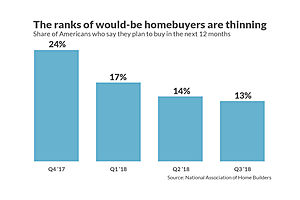
As US housing supply increases, US housing demand continues to drop precipitously. And the need for prices to come down -- way down -- is apparent: "About three-quarters of respondents — 79% — can afford fewer than half of the properties available in their home markets."
 Global Fund Managers More Bearish on World Economy Than at Any Time Since 2008
Nov 13, 2018 - 06:17:11 PST

"According to the BAML survey, 44% of the fund managers expect global growth to decelerate in the next year, the worst outlook since November 2008. What’s more, 54% are anticipating a slowdown in Chinese growth in the next year, the most bearish they’ve been in over 2 years."
 Corporate Debt Repayments Tick Up on the Strength of Repatriated Tax-Break Cash
Nov 13, 2018 - 06:09:51 PST

Demonstrating the sort of forward-looking sanity that has been in short supply on Wall St. lately, public company corporate debt repayments increased to 14% of corporate cash outflows vs. same-period 5% in 2017 and 2016.

As the boys continue their raids on gold and silver, Harvey explains the humongous demand for both gold and silver. Here are the details...

"Long-term oriented investors and speculators should be aware of the near-term trends but they should also be aware of the conditions that will lead to a shift from a bear market to a bull market. Here, we focus on five factors that precede major bottoms in precious metals."
After JPMorgan Silver Trader Admits Manipulation, Ammunition for Other LawsuitsNov 13, 2018 - 05:14:44 PST
"The secret guilty plea in October by a former commodity trader at J. P. Morgan Chase, who admitted that he rigged precious metals markets, drew the attention of a lawyer who has already accused the bank of similar conduct."
Goldman Sachs Bear Market Indicator Predicts 0% 12-Month Stock Market ReturnNov 13, 2018 - 04:45:15 PST

"Goldman's bear market indicator — which takes into account the unemployment rate, manufacturing data, core inflation, the term structure of the yield curve and stock valuation based on the Shiller PE ratio — is at a rare 73 percent, its highest level since the early 1970s."
 The "Buy It All" Insanity of the Bank of Japan: BOJ Assets Now Surpass Japan's GDP
Nov 13, 2018 - 04:36:31 PST
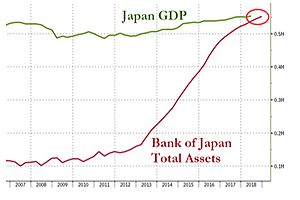
For all the justifiable alarm about US bailout stimulus and asset buying, the Fed's balance sheet is still less than 25% (below $5T) US annual GDP (above $20T). Japan's Central Bank now owns more, over 100% of Japan's annual GDP.
 Bank of France Teams With JPMorgan to Expand Central Bank Gold Bullion Services
Nov 13, 2018 - 04:31:44 PST

As global central banks show more and more interest in acquiring gold bullion and Brexit looms, Bank of France is positioning themselves as a full-service shop offering not just traditional bullion sales but swaps, leases, and other derivative exotica as well.