
Precious metals are apparently waking up. And here is where you can find the best deals.


Site:
Precious metals news


The Institute for Supply Management’s index of manufacturing conditions showed it contracting at the fastest pace since the Great Recession of 2008, while the growth of the services sector also slowed at a worrying pace.


"...has occurred, and now it’s time for investors to get ready for some serious upside action."

Brainard suggested using Treasury purchases to limit how high short- and medium-term government bond yields can rise.
 Dallas Fed: Ballooning Debt Could Suddenly Become a Big Issue for Economy
Nov 26, 2019 - 09:43:02 PST

"If you get two or three BBB-credit downgrades to BB or B, that could lead to a rapid widening in credit spreads," Kaplan warned.

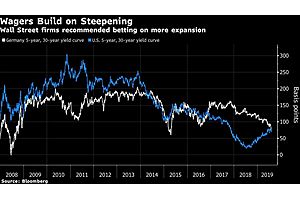
“The economic long-term trends indicate that there will either be a secular slowdown or secularly higher inflation. The steepener should work in both of those environments.”


The OECD proposals would force big companies to pay more in countries where they make 'significant' sales. Pictured: OECD's secretary general and French President in Paris earlier this month.

ignoring that not only is the data deteriorating, but that it is surprising to the downside—a combo that the market has historically not liked,” adding that the Citi U.S. Economic Surprise index fell below zero in the second half of November, indicating that economic data has largely been surprising to the downside.

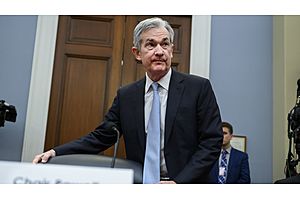
The Fed is waiting to see how the trade war, and other risks to economic growth, shake out.

The price action in gold & silver may be subdued, but gold open interest is dropping, now under 700,000 contracts. Harvey explains...
 US Consumer Confidence Tumbles 4th Straight Month Despite Soaring Stocks
Nov 26, 2019 - 07:28:06 PST
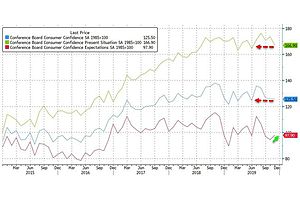
"Consumer confidence declined for a fourth consecutive month, driven by a softening in consumers' assessment of current business and employment conditions,"

"When you get to the last phase of the cycle, you need to be thinking about what could go wrong, because there is probably very little that’s going to go right..."
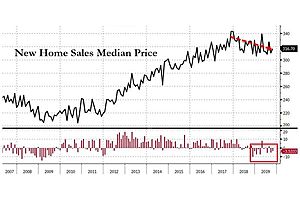
...thanks to a massive upward revision for September (from -0.7% to +4.5%)

Applying its largest fine ever, the central bank’s Prudential Regulation Authority said Tuesday that between June 2014 and December 2018, three U.K. units of the Wall Street bank had significant flaws in the systems they used to report financial information to regulators...
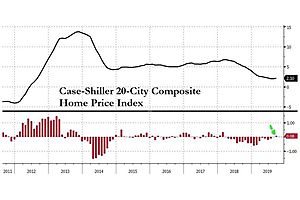
...for the first time since Feb 2018, US Case-Shiller 20-City Composite home price growth accelerated in September

Bankrate's latest study on retirement reveals that almost 50% of American workers have tapped into their accounts before retirement age.
Fed economists warn that printing money to pay for deficit spending, as Modern Monetary Theory proponents recommend, has been a disaster for other nations that have tried it.

China needs to resolve outstanding financial risks, and must counter risks from “abnormal” market fluctuations that stem from external shocks...


America's economy is built on consumption. Average Americans have been pushing the US economy along, spending money they don't have. But as we've reported, there are signals that the credit cards might be close to maxed out. Now there appears to be another warning sign - the wealthy are reining in their spending.

Poland has repatriated 100 tons of gold from England. National Bank of Poland Governor Adam Glapiński announced the yellow metal's return home on Monday.“The gold symbolizes the strength of the country,” Glapiński told reporters.

People’s Bank Of China, said that about 13 percent of the country’s financial institutions were considered “high risk,”...